We are customer zero
The hardest question for any QA product is also the fairest: do you trust it enough to use it on yourself?
At Venkat, our answer begins with our own product. We use our onboarding, project setup, saved tests, Runs, and evidence requirements to judge whether a result is useful. If the report does not help engineering and QA move forward, an agent completing the steps is not enough.
That discipline keeps the work focused. Always-on QA across Web, mobile, and desktop only matters when each consequential journey works from start to decision.
venkat.ag provides evidence — context and AI enable it.
Start with the critical journey
The first critical journey is deliberately simple: landing page to first trustworthy report. It is the smallest path that contains the full promise of Venkat.
A customer understands the product, signs in, enters an isolated Workspace, creates a Web Project, saves a Test, starts a Run, watches the work, and receives a result they can use. Every part matters. A green check without context is not a report. A replay without an assertion is not a result. A failure without reproduction steps is work pushed back onto the team.
For an engineering or QA leader, the real outcome is not “the agent ran.” It is “my team knows what happened and what to do next.”
Context and AI turn product understanding into evidence
Context as a Service means Venkat understands your app the way your ideal customer does: what they are trying to accomplish, how they expect the journey to work, and what success looks like.
venkat.ag provides evidence — context and AI enable it.
Evidence is the product
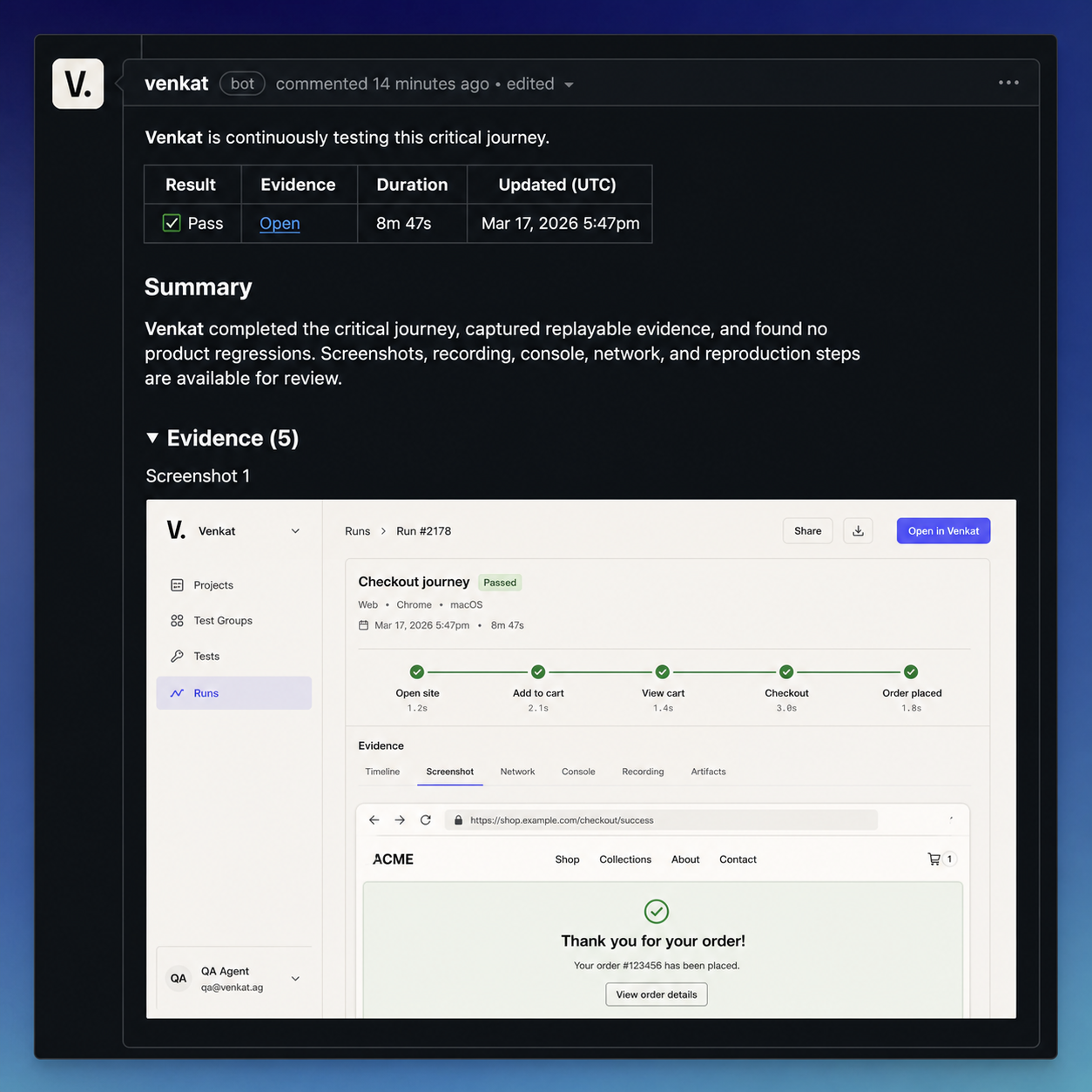
We do not want Venkat to say, “I think checkout is broken.” We want it to show the exact step, assertion, screenshot, recording moment, Console error, Network failure, and reproduction path that support the conclusion.
That is what turns automation into a release decision. A developer can investigate without recreating the run. QA can compare the result with the saved expectation. A product leader can understand customer impact without reading an agent transcript.
It is also why Venkat separates FAILED from ERROR:
- FAILED means the customer product violated an expectation and the evidence supports that conclusion.
- ERROR means Venkat could not reliably tell — perhaps the browser failed, a credential was unavailable, required evidence did not finalize, or cleanup left uncertainty.
Infrastructure trouble should never masquerade as a product regression. That distinction becomes essential when a result appears on a pull request or influences whether a release moves forward.
Predefined tests protect the past. Dynamic tests investigate the change.
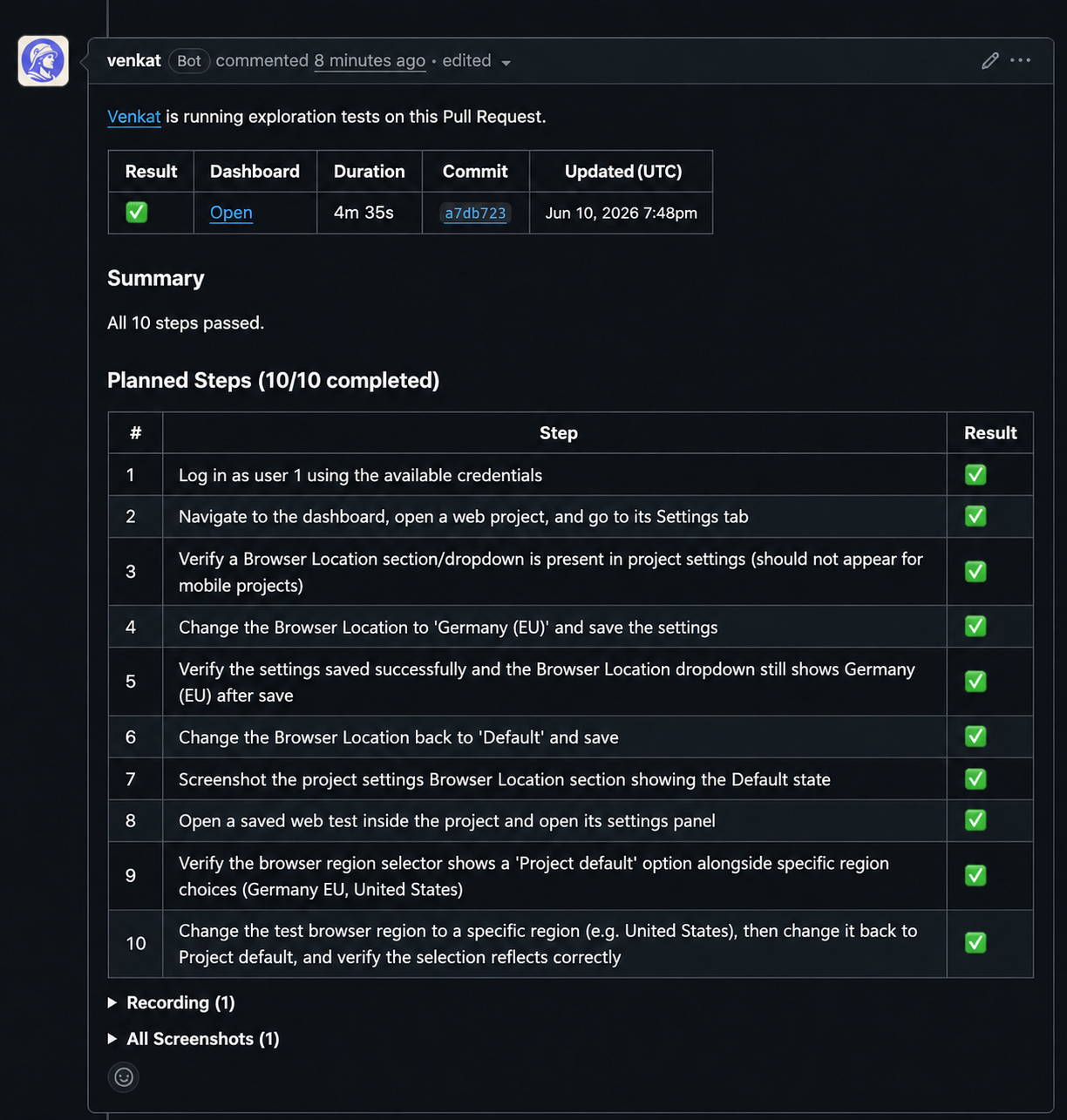
Predefined tests only cover what we thought to write down. A useful PR workflow pairs saved coverage with dynamic tests: the agent reads the pull request — the diff and the description — and plans a fresh set of steps targeting exactly what changed. Whatever the saved suites do not cover, the dynamic plan goes after.
The long-term model is cumulative. Venkat carries forward approved product knowledge: your ideal customer profile (ICP), critical journeys, expected behavior, past failures, and the parts of the product tied to revenue, trust, or operational risk. That memory gives each new test the business context to interpret what it finds.
Whether an issue is P0 or P1 depends on your business, not a generic severity table. A failure that blocks the core customer from a critical outcome may be P0; a similar symptom in a secondary path with a safe workaround may be P1. Priority should be connected to evidence and known product context so teams can see why it matters.
The operating model is straightforward:
- Let a coding agent bootstrap the tests through the customer CLI instead of configuring everything by hand.
- Enable dynamic tests on pull requests so new coverage follows the change rather than waiting for the suite to catch up.
- Schedule core Test Groups so critical regressions surface within hours, not days.
Cross-application QA, by hand
GitHub App logic is one of the best examples of the work we want Venkat to own. Verifying it means acting across multiple applications: pushing a commit, watching a webhook arrive, opening the pull request, checking the reported status, and following the evidence back into Venkat.
Traditional test automation prefers one application and a predictable script. Real product journeys do not respect that boundary. They cross browser tabs, identities, inboxes, third-party services, and asynchronous state.
Those are the flows Venkat is designed to test for you. By hand. The agent performs the same visible work a careful QA engineer would, while Venkat keeps the scope, credentials, evidence, and result deterministic.
The operating loop we want on every team
Saved and dynamic tests have different jobs, but they belong in one operating loop:
- Save the journeys that already matter. Login, onboarding, checkout, publishing, and account recovery should not depend on someone remembering to retest them.
- Investigate what changed. Let the pull request create new questions instead of pretending yesterday's suite knows tomorrow's risk.
- Run continuously. PR triggers protect the merge; schedules protect production.
- Bring back evidence. Screenshots, recordings, reproduction steps, Console, and Network records should travel with the result.
- Make one decision. Passed, product failure, or QA-system error — with enough context to act.
Bring us one critical journey
We are welcoming engineering and QA leaders who have one consequential Web or mobile journey and want to shape how Venkat tests it, explains it, and reports it.
Bring the flow that costs your team sleep: the checkout that crosses a payment provider, the onboarding that depends on email, the GitHub integration that moves through webhooks, or the mobile journey that fails only on the device customers actually use.