DYNAMIC TESTS
Change-focused Tests for matching Vercel previews. Assisted pilot · not generally available.
 QA.army
Test your mobile apps, web apps, and websites, not just diffs - so you ship with confidence.
10 free Runs per new Workspace · No monthly renewal · No credit card required
Describe a flow the way you would explain it to a colleague. QA.army agents follow it in a real browser or on a real device build.

Continuous verification on every PR diff before code hits production.
Change-focused Tests for matching Vercel previews. Assisted pilot · not generally available.
Predefined tests from the dashboard.
Everything required for continuous, reliable verification without brittle selectors, fragile test maintenance, or false alarms.
Captchas, OTPs, email, SMS and SSO - handled.
SAML / OIDC
1567 is your QA.army verification code. Don't share it with anyone.
Video, screenshots and network logs included.
GitHub, CI/CD, Slack, Discord and more.
Test web, iOS and Android.
Coding agents invoke tests, triage results, and update coverage autonomously.
Understands routes, state machines, and business quirks across runs.
A four-step loop, wired straight into the software delivery lifecycle you already run.
Paste a staging or production URL, connect a GitHub repo, or upload an iOS/Android binary. No SDK, no probe injection, no scripts to maintain.
$ ta init
✓ detected: web + ios
✓ preview URL bound
✓ ready in 42s
“Sign in with Apple, add two mugs to cart, check out with the saved card.” The agent handles OAuth, OTP, and every quirky UI in between.
PR checks via GitHub App. Production monitoring on a schedule. Webhook triggers from CircleCI, GitHub Actions, or any CI. Parallel runs finish large suites fast.
✓ PR #482 · dynamic + saved
✓ 24 flows · 6 parallel
✓ 1 regression → blocked merge
Every run ships screenshots, video replay, browser + network logs, and an actionable bug report — in the dashboard, in the CLI, or right on the pull request.
QA.army is tuned specifically for QA: critical journeys, explicit result semantics, isolated runs, and evidence that helps your team understand what broke.
venkat tests create — let your coding agent grow the suite as it ships.Every decision in QA.army is tuned specifically for QA: critical journeys, explicit result semantics, isolated runs, and evidence that helps a team reproduce what broke.
Pick a plan or start with 10 free Runs — no credit card, no sales call, no scripts.
For teams shipping daily across web + native.
Try QA.army on your live URL. Start with the journeys that matter most.
“The replay bundle gave me the failing step, screenshot, and console error. I fixed the checkout issue in one commit.”

“QA.army read our OAuth diff, planned four checks, and caught a stale-session bug we had missed.”

“Saved tests protect known journeys. Change-focused tests probe what each pull request puts at risk.”

QA.army is the always-on QA agent for web, mobile, and desktop: it tests critical journeys and returns evidence-rich bug reports.
Paste the QA.army setup instruction above. Your agent can begin the handoff, define seven critical journeys, and request sign-in or an authorized Workspace selection when required.
Core test groups are saved, durable journeys. Dynamic tests plan fresh coverage around a pull-request description and diff. Dynamic pull-request testing is not generally available yet.
PASSED means the required expectations held. FAILED means the product broke an expectation. ERROR means QA.army could not reliably determine the product result. A useful failure includes screenshots, a recording, reproduction steps, and relevant console or network evidence.
Web, mobile, and desktop are all part of QA.army. Native mobile and desktop execution are not generally available yet.
Workspace is the boundary for access and billing. Runs, tests, evidence, and agent access remain scoped to the authorized Workspace and project.
# product
Product Manager
The intro-offer bottom sheet stopped showing after 2FA login in dev.
CEO
@qa.army can you check?

Checked the same journey across all three environments.
API responses and feature flags match. The frontend stops before mounting IntroOfferSheet. Release notes show the auth callback changed in this build.
Pick a priority, then log the ticket.
Provide the QA.army setup instruction to your coding agent. It will define seven critical journeys and confirm what is currently ready to run and monitor.





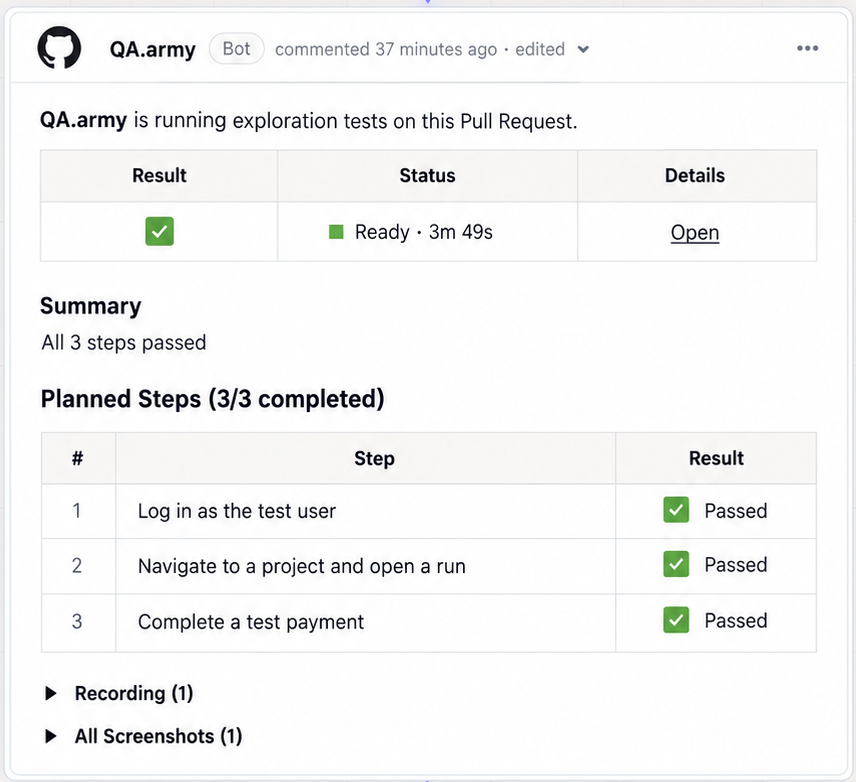
QA.army is running exploration tests on this Pull Request.
Planned Steps (3/3 completed)
▶ Recording (1)
Payment Element Verified
pi_3N4k2...authorized ($64.00)▶ All Screenshots (1)
app.qa.army/payment/success(1440×900 viewport)